
Inciting Incident vs Hook, How to Start a Screenplay
A strong hook grabs attention, and a strong inciting incident launches the story. Learn how to start a screenplay by using conflict to reveal character and world, avoid clunky exposition, and design an Act 1 that pulls audiences in fast, with examples from Children of Men, The Big Lebowski, James Bond, Interstellar, and Fantastic Four.
Light the Fuse: Inciting Incidents, Hooks, and How to Start a Screenplay
Every time someone sits down in a theater or presses play at home, a quiet contract gets signed. A stranger hands you their attention, and in return you promise them something worth feeling. That’s why the hook matters. That’s why the inciting incident matters. In the opening minutes, your screenplay proves it has a pulse and convinces the audience to lean in.
Act 1 is naturally exposition-heavy. You’re introducing the world, the rules, the tone, and the character we’ll follow. On paper, that can sound like homework. The best films solve this the same way every time: they let conflict do the explaining. Instead of telling us how the world works, they crash us into it. Instead of describing the character, they put them under pressure and let us watch what they do.
Writers often blur two terms here, so let’s clarify. The hook is the immediate grab, the early jolt that pulls us in and starts revealing the story’s tone and trouble. The inciting incident is the story engine turning over, the first major disruption that forces the protagonist to respond and pushes the plot onto its track. Sometimes they’re the same moment. Sometimes the hook happens first, and the true inciting incident lands a few beats later. Either way, you want that fuse lit early.
Children of Men is a masterclass. Theo buys coffee, casually spikes it with booze, and we absorb his numbness and the film’s bleak atmosphere without a speech. Then the coffee shop explodes behind him. The hook isn’t only the blast, it’s what the blast reveals: catastrophe is normal here, and the world is unstable in a way people have learned to endure. That’s exposition delivered through impact.
The Big Lebowski does the same job with a different instrument. The Dude comes home and gets jumped by two thugs. In one disruption, you get tone, character, and plot injection. He isn’t defined by a monologue, he’s defined by his reaction, a guy in jelly sandals being dragged into chaos like it’s an inconvenience. That’s how you make setup feel like story.
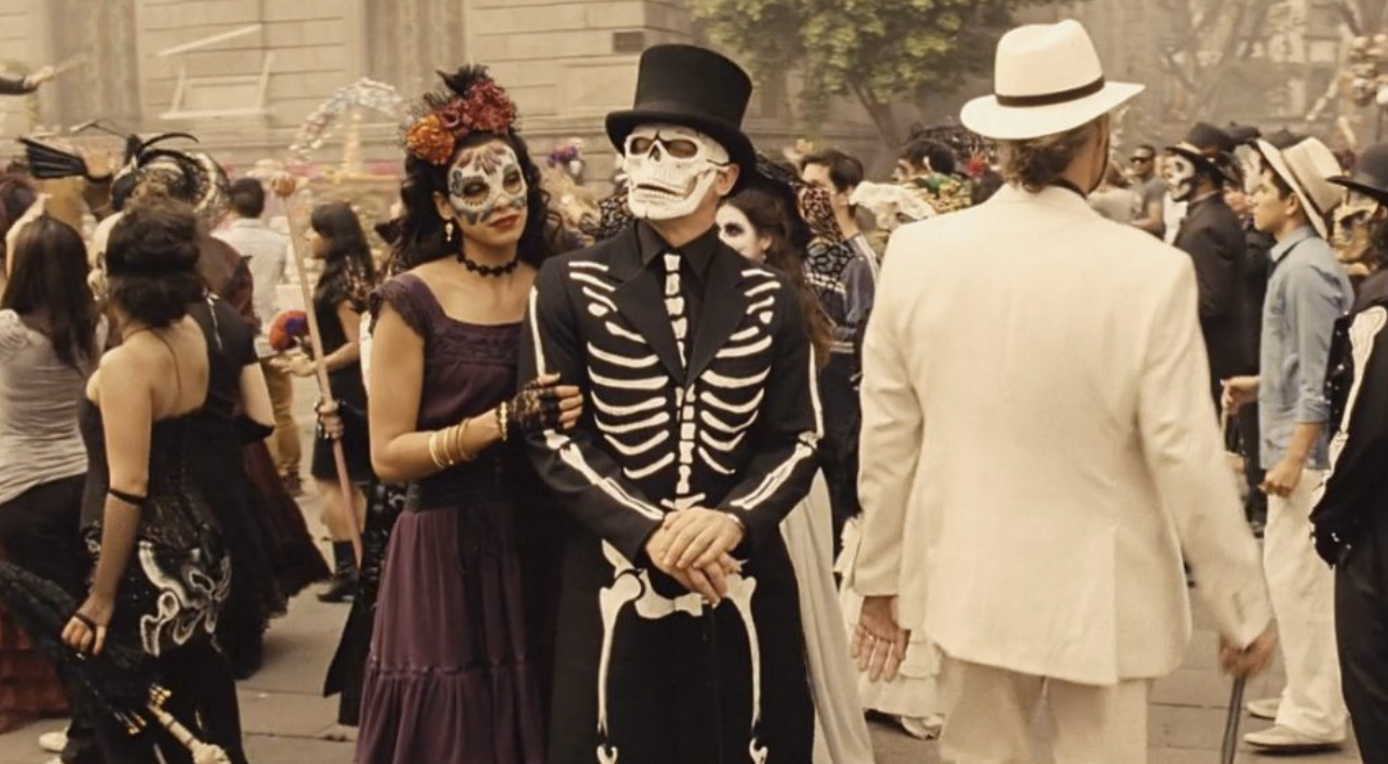
If you want the purest example of “hook as promise,” look at the cold open of a James Bond movie. The pre-title sequence is a short, concentrated statement of identity and tone. Spectre’s Day of the Dead sequence drops Bond into Mexico City’s masked celebration, moves through an assassination attempt and a collapsing building, then escalates into a chase across a crowded plaza and an acrobatic helicopter fight above thousands of people. It’s spectacle, yes, but it’s also orientation. In minutes, you know the rules of the world and the competence of the character.
Hooks don’t have to be loud, though. Fantastic Four opens with Sue holding a positive pregnancy test. No chase, no explosion, but the stakes are immediate and irreversible. That single image reframes everything through a human lens, vulnerability, responsibility, and the future. Quiet can be just as propulsive as chaos if it changes the air in the room.
Interstellar gives you a “hook as worldview” with the drone chase. Cooper and his kids go after a downed surveillance drone, and in one sequence you understand scarcity and salvage, plus who Cooper is: a problem-solver, a risk-taker, a man still wired for flight and the pull of the horizon. Again, the film avoids speeches. It dramatizes the world through pursuit and need.
This is the core lesson: conflict is the most elegant delivery system for information. When something goes wrong, we learn. When the character is threatened, we learn what they value. When the world applies pressure, the character reveals their shape. Exposition stops feeling like explanation because the audience is tracking a problem.
If you’re building your own opening, don’t start with “How can I make something big happen?” Start with better questions. What is the first disruption that cannot be ignored? What event forces your protagonist to respond in a way that reveals who they are? What does this moment teach us about the world without explaining it out loud? What domino falls that makes the rest of the movie feel inevitable?
Ultimately, a great hook makes a promise: this story is worth your time, this world is specific, this character is human, and this journey is going somewhere. In an age of infinite content and fractured attention, that promise matters more than ever. Your opening doesn’t need to be louder than everyone else’s. It needs to be truer.
So light the fuse. Put your character in the world. Let the world push back. Let the first disruption arrive like a knock that won’t stop, like a test result that changes everything, like an explosion that makes the ordinary unbearable. Then let your protagonist do what only they would do, and in that choice let us recognize a piece of ourselves. That’s the hook. That’s the inciting incident. That’s the first promise you make to the audience, and if you make it honestly, they’ll follow you anywhere.
AI and Screenwriting, Why Writers Still Matter
AI It is changing data analytics. It is changing art. It is changing how humans express what it means to be human. Screenwriting is no exception.
A Real Example: When AI Replaces the Writer
AI is a new technological frontier that is reshaping nearly every part of modern life, from data analytics to the way we create and share art. Screenwriting is no exception. In fact, the rise of AI was one of the key issues at the center of the 2023 Writers’ Strike, because it raised real questions about authorship, credit, and whether human writing would be treated as a replaceable commodity.
AI is here, and AI is writing screenplays. I know because I have read some of them. In many cases, the output can resemble a script at first glance. It might include scene headings, character names, dialogue, and even the occasional plot twist. But the deeper question is not whether AI can generate pages. It’s whether it can tell a cinematic story that connects to human beings through lived experience.
I recently started a writing project with an old friend. We talked through the concept together, and I began the process the way professional projects often begin, by writing a treatment. A treatment is typically a short document, around five pages, that lays out the story in a clear, cinematic way. The plan was to use this treatment to help raise funding and move toward a full screenplay, including my fee to write it.
Then, after some time passed, my friend told me, “Don’t worry about writing the script, I just had AI do it.”
On one level, I felt betrayed. I had done the foundational work, and the script was supposed to be the next step. Outsourcing that step to a machine felt like cutting me out of my own contribution. At the same time, I was intensely curious. If AI had written a screenplay based on my treatment, I needed to see what it looked like.
So my friend sent it to me.
The document technically had the parts you would expect: characters, dialogue, and scene description. It was attempting to translate the story from my treatment into screenplay form. But it immediately revealed problems. The formatting was inconsistent and unprofessional. The page was flooded with parentheticals that read like constant direction to the actors, the director, and the editor. Even worse, it still contained prompt language, the kind of text that belongs in a chat window, not in a screenplay anyone should take seriously.
Those flaws were visible. The bigger flaw was deeper.
The script had no soul.
Reading it felt like trying to have a heart-to-heart conversation with a Magic Eight Ball. The responses were technically words, but they did not carry emotional truth. The scenes did not feel inhabited. The people didn’t feel like people. It was the difference between imitation and experience, between pattern and perspective.
So yes, AI can generate a feature-length script if you ask it to. You can request 110 pages and get something that resembles a screenplay on the surface. But at this stage, what AI cannot do, and may never fully do, is bring human interiority into the work in a way that moves other humans. A screenwriter is not just assembling plot events. A screenwriter is translating lived experience into cinematic language: behavior, subtext, silence, pressure, consequence, and change.
AI can’t tell your story. It can’t access emotional truth the way a writer can because it has not lived a life. It has not fallen in love. It has not grieved. It has not had that private moment when a film line hits you so hard you feel your direction shift, like “Carpe diem. Seize the day, boys.” It has not watched an impactful film on a screen and said, " This is what I was meant to do.”
That does not mean AI has no place in the creative process. Used ethically, it can be helpful for research support, summarizing background material, organizing notes, or generating idea variations when you are stuck. It can function like a tool, and tools can be valuable. But storytelling is not fundamentally about algorithms. It is about empathy, perspective, and the human ability to recognize ourselves in someone else’s struggle. If you want to think of great character names that would feel right at home in your character’s neighborhood in Newfoundland, AI’s your guy. AI is great at providing objective notes about your script (It’s also great at blowing smoke up your ass, so be careful here.)
In the end, the point of screenwriting is to communicate humanity through cinematic storytelling—to connect with other humans through this beautiful art form. A screenplay is not just properly formatted pages. It is a human experience shaped into a cinematic journey that makes someone in a dark theater feel understood, connected, and less alone. AI can assist with the scaffolding. It cannot supply the soul. That part still belongs to the writer, and it always will.
If you want to learn how to better express umanity through cinematic storytelling, check out my course Screenwriting 101: How to Turn Your Idea Into a Screenplay.

The Gospel of Screenwriting
Narrative storytelling is wired into us as humans. It has been our survival tool that has taken us from painting storied buffalo hunts on cave walls, through Shakespeare, to the Coen brothers.
Hello, screenwriting world.
I’m Chris Moore (UCLA MFA). I’m a screenwriter, producer, and director with nearly 20 years in film, television, social media, and branded content. Quick clarification, I’m not the Chris Moore who produced Manchester by the Sea, Project Greenlight, or the American Pie series. Different Chris Moore, same love of movies.
I recently launched a 10-part audio screenwriting course, Screenwriting 101: How to Turn Your Idea Into a Screenplay. It’s built from core UCLA screenwriting fundamentals, plus two decades of real-world experience in the entertainment industry. My goal is simple: help you turn “That would make a great movie” into a professional-looking screenplay that holds up to a reader, an agent, a producer, or a studio exec.
These Gospel of Screenwriting posts are where I keep teaching in public.
I’ll share practical screenwriting tips, examples, and momentum tactics, including:
• screenplay structure (including three-act structure)
• outlining and writing a treatment before you draft
• screenplay formatting basics that make you look pro
• scene work, character wants, and raising stakes
• finishing strategies so your script doesn’t die in Act 2
This is The Gospel of Screenwriting.
Why I care about this craft:
I’ve been writing in one form or another since I was young, but the love of storytelling and the love of cinema collided in 1989 when I watched Dead Poets Society (written by Tom Schulman). I walked out of the theater changed. I remember thinking, I want to write movies, and I want them to make people feel like that.
Years later, I was in a corporate job that felt like a workplace comedy with none of the humor. On a rare vacation, my wife asked me a simple question: If you could do anything, what would you do? Without overthinking it, I said, “I want to write screenplays.”
That moment changed my life. It’s when screenwriting stopped being something other people did, and became something I could do. A few years later, I got accepted into the UCLA screenwriting program, and it reshaped the direction of my work for the next two decades.
Why cinematic storytelling matters
Storytelling is wired into us. Yuval Noah Harari calls it a human superpower, and he’s right. We don’t just trade facts. We make meaning through narrative, and we remember stories longer than we remember data.
Filmmaking takes that ancient instinct and turns it into something massive and collaborative. Look at any film set. Dozens, sometimes hundreds of people working toward one emotional result. And the entire process starts as an idea in the mind of a screenwriter.
That idea becomes words on a page. Then it becomes a living thing, shaped by actors, directors, cinematographers, editors, composers, and crews. When it’s done well, it reaches millions of people across cultures and generations. It can make you laugh, cry, rethink your life, or feel less alone.
Movies don’t just reflect culture. They help create it.
If you can quote “May the Force be with you,” or “You can’t handle the truth,” you already understand how screenplay dialogue becomes part of everyday life.
So here’s my invitation
If you’ve been carrying a movie in your head for years, I want you to stop waiting for permission. I made Screenwriting 101 to give you structure, tools, and forward motion. Not theory that lives in a book. A process that gets you to pages.
If you want to start, here are two good next steps:
Explore Screenwriting 101: How to Turn Your Idea Into a Screenplay
Subscribe to The Gospel of Screenwriting
Let’s start writing your screenplay together.